The baseball cameo in Margo Price’s new video

Over the years, I’ve developed an eye for references to or images of baseball in other aspects of pop culture. More than just Andy Warhol’s baseball paintings or the wallpaper in a scene from Seinfeld, something in my brain will register at just a hint of a nod to the national pastime.
This ability kicked in recently when I was watching the video for “Twinkle Twinkle,” the first single from a new album (That’s How Rumors Get Started, out May 8) by country singer-songwriter Margo Price. As reviews have noted, the song is more of a rocker than a lilting country tune, and the video is a psychadelic, kaleidoscopic trip with some cut-and-paste aspects akin to a Monty Python animation.
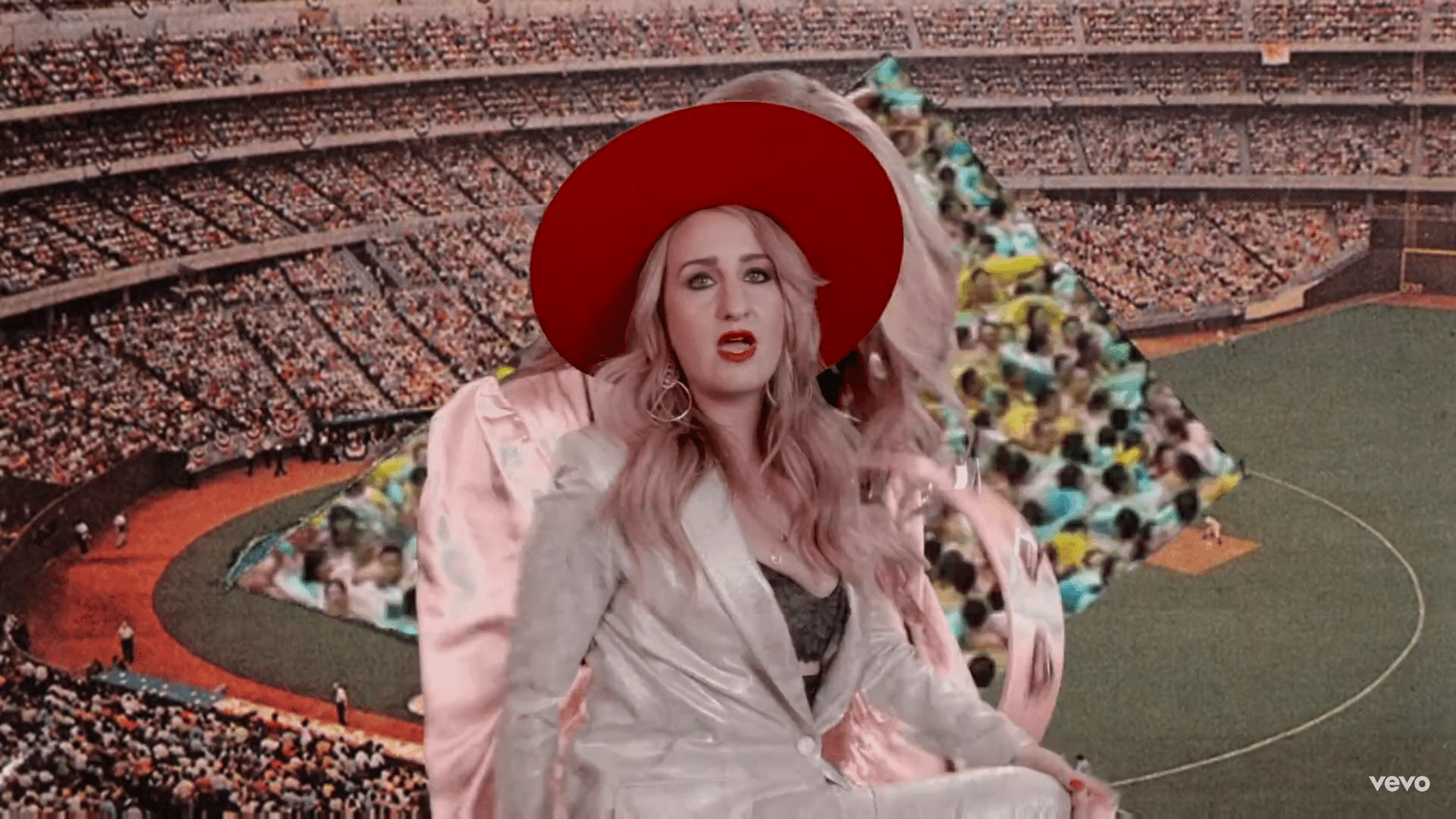
Baseball makes a brief appearance at the 3:01 mark, when Price is superimposed over a ballpark, with the infield clearly visible and packed stands with bunting draped throughout the stadium. The tiered stands and Astroturf field — with the distinct cutout around second base — make it clear that this is one of the multipurpose stadiums built in the 1960s and ’70s, also known as “cookie-cutter stadiums,” “concrete donuts” or, my favorite, “concrete ashtrays.”
Eliminating domed stadiums like the Astrodome or Metrodome left five possibilities among circular outdoor stadiums with artificial turf: Atlanta-Fulton County Stadium, Cincinnati’s Riverfront Stadium, Philadelphia’s Veterans Stadium, Pittsburgh’s Three Rivers Stadium and St. Louis’ Busch Memorial Stadium. It didn’t take me long to search images of those five parks to find the right configuration of seating decks, the left-field corner and yellow markings on the outfield wall to determine it is Riverfront Stadium.
But I wanted to know more, if I could, so I continued to hunt for the source image until I found it in this postcard.

Listings of the postcard for sale online describe it as a 1970s postcard, which seems likely based on the image quality alone. But what game? The packed stands and red-white-and-blue bunting hint at a marquee event, like Opening Day (a holiday in Cincinnati) or the World Series (the Reds appeared in the Fall Classic in 1970, ’72, ’75 and ’76). It’s between innings, because the home-plate umpire is standing straight while the pitcher throws and the batter stands just outside the cutout around home plate. The third baseman is making a throw toward the bag at second base, where the second baseman waits. The first baseman is also standing on his bag.
As I continued to look over the image, a few other details caught my eye. The field umpires are wearing light-blue shirts, and out in left field, it appears that a ballboy (perhaps warming up the left fielder) is standing close to another umpire. This is not Opening Day, because umpires are only stationed down the left- and right-field lines in the postseason … and for All-Star Games.
That’s when I looked back again at the dugouts and saw what appears to be a stars-and-stripes design on the roof of the first-base dugout and an “N” logo in the nearby on-deck circle. The Reds used the first-base dugout, and the home team in the All-Star Game — in this case, the National League — traditionally uses the home-team’s clubhouse and dugout. A quick check of All-Star Game sites confirmed that the 1970 Midsummer Classic was played in Cincinnati, just two weeks after the stadium opened.
Various images of the 1970 All-Star Game show the bunting in place, including shots of what may be the most famous play at the plate in baseball history, Pete Rose bowling over Ray Fosse to score the winning run in the bottom of the 12th.
I’m also comfortable in saying this postcard shows the 1970 All-Star Game for two other reasons. One is what appears to be different colored caps on the pitcher and first baseman, as well as the third baseman and middle infielders. Unfortunately, the image is not clear enough to be sure. But let’s consider the umpires again. With cooler temperatures in October, umpires in the field would be more likely to wear their black jackets rather than the light-blue polo shirts, and a few images from World Series games at Riverfront Stadium do indeed show jacketed umpires, even for games played during the day (the ’70 Series was the last with no night games).
There were several other notable aspects of this 41st Midsummer Classic. It was the first All-Star Game played at night, and every one since then has been, too. (A 28.5 Nielsen rating, the highest for an All-Star Game to this day, certainly helped.) President Nixon threw out the first pitch from his front-row box seats and stayed for all 12 innings. He was the third president (after FDR in 1937 and Kennedy in 1962) to attend an All-Star Game. The rosters for the teams featured 21 future Hall of Famers, 13 of whom would get in on the first ballot if you count Roberto Clemente.
BUT! There’s one more aspect to this hunt that came up as I searched images online. This postcard was used by artist Ellsworth Kelly for one of his postcard collages, more than 400 of which he made from 1949 to 2005. The Tang Teaching Museum on the campus of Skidmore College in Saratoga Springs, N.Y., has an exhibition of Kelly’s postcards planned for 2021.
Now take one more look at the screengrab of Margo Price in her video.
Behind her is an image of a crowd in pastel colors — not the baseball crowd, but a different group of people taken from a closer vantage point. It’s superimposed over the postcard but behind Price in an abnormal shape that appears to have four sides. The outline of this superimposed crowd follows exactly the piece of paper or fabric Kelly adhered to the postcard in his 1980 collage, meaning the postcard used in Margo Price’s video is not just the postcard of Riverfront Stadium from the 1970 All-Star Game, but it’s actually the Kelly creation with the black four-sided shape used like a green screen for the image of the second crowd.

So this one-second — if that — flash of a stadium in the video for “Twinkle Twinkle” features not just an intersection of music and baseball, but of music, baseball and fine art. It’s crazy where the paths can lead when you start to follow them and how the search for an answer to one question can lead to answers for two more you didn’t know you had.